

Travelling independently as a retired or inter-ability couple brings many advantages, particularly when you finally get to visit distant destinations such as the Galapagos Islands. As slow travellers, independent travel frees us up to travel where we want, eat when and where we want, and have uninterrupted and unrushed quality travel time in the sites we explore. Freed of the restrictions that even well-organised tours place upon you, the costs are often significantly lower (around 50% per person, or 30% per couple), the quality of accommodation is equal or higher, and the time you spend on the islands longer and more absorbing. No wonder independent and solo travel has risen amongst silver-haired and inter-ability couples, especially during their retirement years.

Since watching the BBC’s ‘The Voyage of Charles Darwin’ as a child, topped with an academic background in genetics/environment and encouraged by David Attenborough programmes, I have wanted to visit the Galapagos Islands. In April 2024, I finally made it to the archipelago. The only problem was that I was now severely sight impaired and unable to snorkel or scuba dive anymore – but what else could possibly go wrong? In fact, I now seemed to have less mobility than a Giant tortoise over lava rocks or a sea lion crossing a sandy beach. However, our 12-day itinerary had taken this into account. My limitations through disability were catered for, and more importantly, we had allowed space and times for Jane to head off and conduct more active water sports and sightseeing trips whilst I engaged in solo land-based pastimes.
Our 12-day route involved island hopping using the ferries between the four main inhabited islands. We hoped to see as many species as possible by using the many free sites within the Galapagos Islands National Park, which often possess a small network of accessible hiking paths.

This blog sets out the 12-day itinerary we followed, giving tips on where to visit and stay and the experiences readily available to all travellers regardless of ability. As an inter-ability couple, the tour is biased towards a slower pace of travel than many of the one-week travellers we met and spoke to, and our desire to stay longer on some islands (Isla Floreana in particular) than most other visitors were able to achieve.
- Tourism in the Galapagos.
- Day 1: Fly into San Cristobal and compete for benches with sunbathing sea lions.
- Day 2: Organise your own Highland Tour.
- Day 3: Interpreting the Galápagos National Park Visitor Centre and Hiking to Playa Punta Carola Beach
- Day 4: Transfer to Santa Cruz, Las Grieetas and the Kiosks.
- Day 5: Isla Pinzon, the Puerto Ayora Fish Market and photobombing Pelicans.
- Day 6: Ferry to Isla Floreana, Island life, Pirate Caves and a Labyrinth – plus more Giant Tortoises
- Day 7: Black Beach,
- Day 8: Kayaking at La Loberia.
- Day 9 – Isabella Island – even more tortoises and… at last, Flamingos.
- Day 10: Concha de Perla and Los Tuneles.
- Day 11 – Back to Santa Cruz, the Darwin Centre and luxury on a Highland Coffee Farm.
- Day 12 – A relaxed morning and afternoon flight out to Quito.
- Some Final Travel Advice

Tourism in the Galapagos.
The Galapagos Archipelago consists of 13 major islands with numerous smaller islands, islets and reefs; the Ecuadorian government designated 97% of the land area as a national park. The remaining 3% of undesignated land is allocated for human use, primarily within the islands of Santa Cruz, San Cristóbal, Baltra, Floreana, and Isabela. The Galapagos has a permanent population of around 32,000 people centred around the main towns of Puerto Ayora (Santa Cruz), Puerto Baquerizo Moreno (San Cristóbal), Puerto Villamil (Isabela) and Puerto Velasco Ibarra (Floreana).
As a tourist, you are funnelled through two primary travel routes within the Galapagos: sailing or cruising trips or island-based holidays and tours. The Ecuadorian government controls both alternatives carefully, with cruises and offshore trips carefully controlled to limit the number of boats visiting locations and how often that location is visited. Access is denied or made onerous on land across most of the park. Tourists are directed towards the more resilient locations (notably the seashore and beaches), allowed access only with a registered guide, or where they walk dictated by marked trails and boardwalks through sensitive habitats. Free roaming across the Galapagos is not an option you soon realise!
Island hopping offers visitors much more independence and flexibility to have the holiday experience they want. However, cruises will access more distant offshore sites, but this comes with a higher budget price, and the time spent at specific locations is often short. Bear in mind that many cruises and land-based tours claim the day you arrive and the day you leave in the final day count (if they haven’t already claimed the flight-to-site times in the count), limiting an 11-day trip to a 9-day or less tour, or a 5-day tour for those advertised as 7 days, despite the fact you are receiving little in services except pick up or departure arrangements. Organising your trip is not difficult using the standard range of internet tools; it just takes time and research.
Travel Tip: Any Galapagos itinerary requires at least a half-day of travel added to both the beginning and end of the visit to allow for your return to the mainland. You must fly from one of the two mainland airports in Guayaquil or Quito.
For added travel advice and tips, read our blog, ‘Preparing to visit the Galapagos—Some Travel Hacks to Improve Your Holiday’.
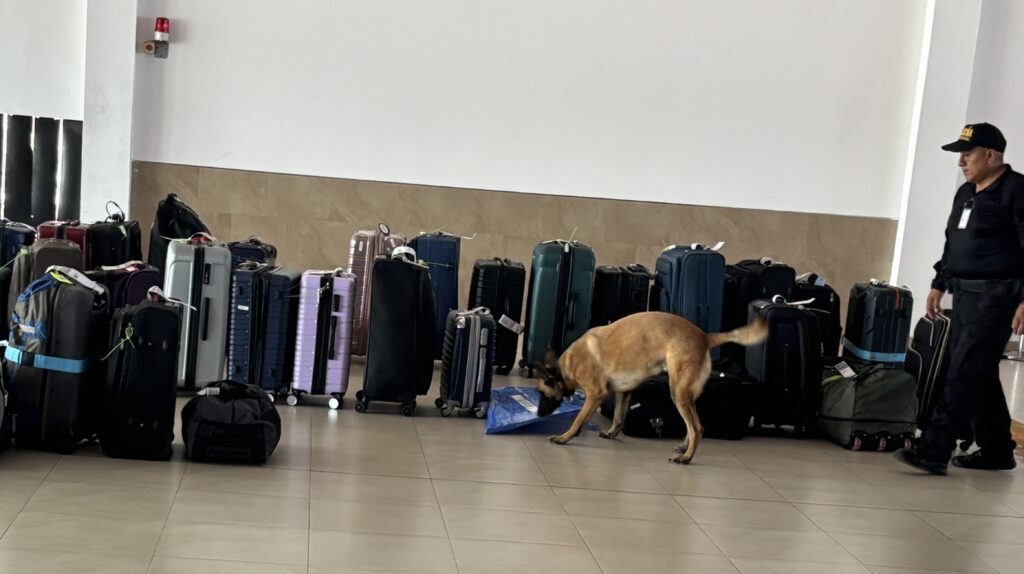
Day 1: Fly into San Cristobal and compete for benches with sunbathing sea lions.
Airport Isla San Cristobal (SCY) is on the outskirts of Puerto Baquerizo, San Cristobal. It is a much simpler arrival possibility for new visitors to the Galapagos than flying into Baltra Island (Santa Cruz’s airport) on their first day. San Christobal makes for a more attractive base for a few days, and once one of the Galapagos’ 4×4 Taxi pickup trucks has whisked you to your accommodation in the town within a few minutes, it’s time to explore.
Travel Tip: If you are flying in from the mainland, try booking a multi-city flight from Guayaquil (GYE) to San Christobal (SCY). Then, fly out from Baltra Island (GPS) to Quito (UIO), adding a short connecting flight from Quito (UIO) to Guayaquil (GYE) if needed.
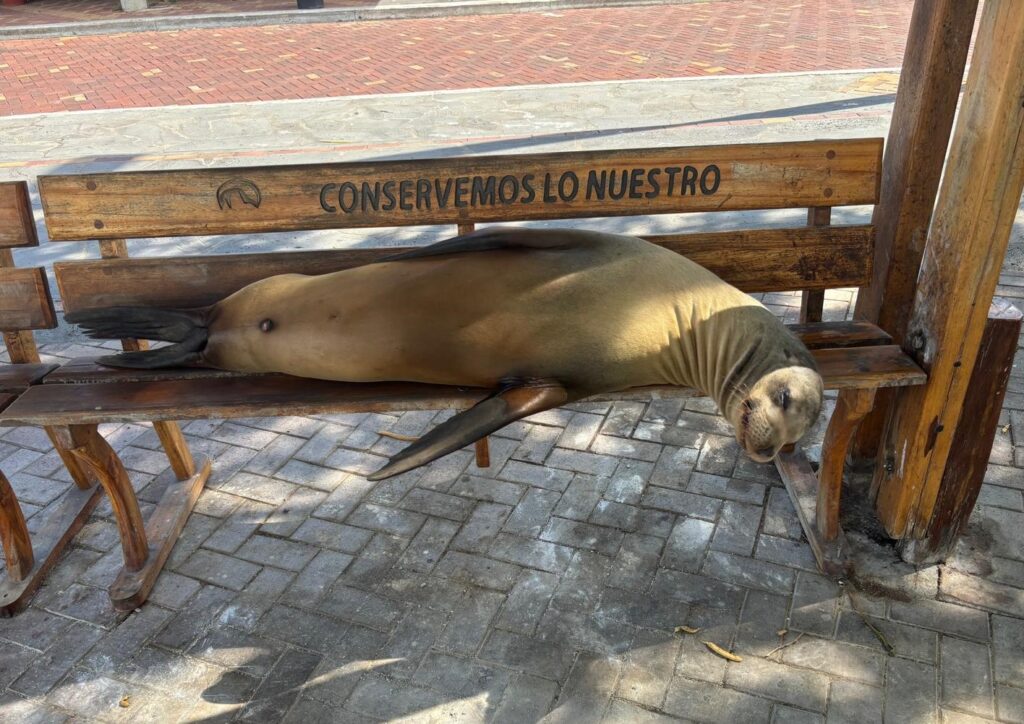
Head down to the seafront on Av. De la Armada National (on the left-hand side of the seafront), keeping an eye out for some brightly painted pedestrian bridges as sea lion pups can often be found playing in the waters below or coming down the channel to join their companions. Meanwhile, their mothers doze on surrounding wooden park benches and under the trees. Watch out for the local sport of ‘sealion pup hurling’ as concerned locals stop to rescue one of the sea lion pups that has managed to get stuck on the rough stone wall bordering the channel, gently tipping them back into the water or the indifferent interactions between the local dogs being walked on the beach and sea lions on the sand (my English Setter would be going bananas at the sight of these legless cats!).

All along the Puerto Baquerizo beachfront, as the afternoon draws on, sea lions will start to haul themselves out of the water and find sleeping spots. During our whole time in the Galapagos, we never encountered a more significant colony of sea lions (and some fur seals) or could see them so close up. Sealions are not the only attractions here, as sitting on the rocks, you can see small marine iguanas and Sally Lightfoot crabs, whilst a few blue-footed boobies and brown pelicans dive acrobatically into the harbour.

Travel Tip: Listen to the males ‘urk’ repeatedly, and try and identify ‘The Big Urk’, the one with the loudest, most repeated calls, who is the beach alpha male, giving himself high blood pressure and excessive lifestyle stress as he constantly warns off other marauding males. The other sound you will hear softly in the background is the suckling pups as they are nursed by their mothers – a very low slurping sound.

There are a variety of restaurants and cafes along the seafront/Avenue Charles Darwin and on the side streets behind. One place to try during your trip is the Post Office Galapagos because of its proximity to the Sealion colony, simple but tasty food, and range of good draft beers.

Day 2: Organise your own Highland Tour.
Today, cross San Christobal Island on your own Highland Tour. You can easily arrange this tour on the morning you wish to go on it; it doesn’t need to be pre-booked through a tour agency as every taxi driver knows it and will usually ask if you have already been on it. The tour takes around 5 hours, and the taxi drivers typically try to finish it just before the snorkelling day trips return to Puerto Baquerizo harbour in the afternoon. The tour follows a set route, crossing the island from west to east. First, it visits El Junco, a collapsed volcanic caldera within which a freshwater lake has formed and usually an excellent spot to watch frigate birds bathe; secondly stopping off outside La Galapaguera – the island’s tortoise research and conservation breeding centre; and finally, Puerto Chino Beach – an isolated small beach enclosed by headlands with perfect white sand where you can swim with turtles, the local colony of sea lions and watch blue-footed boobies on the rocks. The taxi drivers charge around $70-75 USD for the taxi hire (the tour operators typically charge $100 USD per person), and you can negotiate a higher day fee that allows you longer at each site, a lunch stop and any specific additions you want.
Travel Tip: We recommend changing the order in which the taxi drivers like to do the tour and instead visiting the Tortoise Sanctuary first. The tortoises are more active in the early morning and can be seen in the grounds lumbering towards their feeding stations. Then, visit the beach, and finally, on your return to Puerto Baquerizo, hike up El Juno. This meant we were ahead of the crowds and had a much quieter visit at all three locations.

At the tortoise station, we were informed that a licenced guide may soon have to escort you around the site (as required in Santa Cruz, but in Isla Isabella, the Centre’s staff function as guides). This will change the dynamics and cost of the Highland tour.
Accessibility Tip: The circular path within the Tortoise Sanctuary is not accessible or friendly; in fact, it was challenging to walk the entire circuit as the route is rocky and uneven. If you plan on visiting the tortoise nursery section at the top of the hill, it is strenuous, and you will need guidance. Consider following the left-hand path and walking clockwise around the circuit, as the route is flat and even to the main feeding station (ca 150m distant), and then gets significantly more uneven and rougher as it heads up the hill to another smaller feeding station and the tortoise breeding centre at the top of the hill.
Throughout the trip, I and others wondered how on earth such large, ungainly, and lethargic creatures reached such an isolated chain of volcanic islands 1,000 kilometres from the mainland. We received many different answers. Perhaps this article has the answer.
Accessibility Tip: Throughout our Galapagos trip, I often switched to using hiking poles rather than my standard white sensory cane, as they provided better stability and support on the rougher trails.


Puerto Chino Beach is a lovely location, reached by a 20 min walk down a boardwalk through the dry forest with spectacular Opuntia cacti on either side; within the scrub, your companion will spot San Christobal’s Galapagos Finches, occasional Mockingbirds, and Yellow Warblers as well as the small lava lizards basking on the hot stones. Finally, you appear through an archway of trees onto a pure white sand beach within a small bay. It is a perfect spot for taking life easy, sunbathing and swimming. There are no facilities here, so bring your lunch, water, and sunscreen if you plan to stay for a couple of hours. A trail off to the right of the beach led over the rocks to viewpoints, but its accessibility was challenging.

El Junco is one of the few permanent freshwater lakes in the Galápagos. Leaving the driver in the car park below, we strolled (Jane) and stumbled (me) our way to the top of a grassed trail. Take care; the trail can be slippery after rain, and a helping hand is sometimes needed. Although occluded by low clouds on the day we visited, there are often good views of most of San Christobal, including the 900 m peak of Cerro San Joaquin from the crater’s rim. Punta Pitt, the most spectacular site in San Cristóbal, is visible to the northeast. El Junco is one of the best places for your sighted companion to birdwatch and to look out for White-cheeked Pintail Ducks, Common Gallinules and the endangered Chatham mockingbird. The lip of the hill is also one of the few places where you can see frigatebirds bathing in the freshwater to preen their feathers. On the trails through the site, you will pass Miconia bushes and the island’s endemic tree ferns.

Day 3: Interpreting the Galápagos National Park Visitor Centre and Hiking to Playa Punta Carola Beach
After an enjoyable but unusual breakfast combination at XXX where I chose to try for the first time the popular breakfast dish Bolon de Verde (cheese and meat encased in mashed plantains). Try it, it is delicious, but remember that after eating this edible Ecuadorian cannonball, please do not try to go swimming for at least a decade!

The Interpretation Centre is often described as a ‘must see‘ location in many San Christobal blogs and websites. Still, it left me rather unimpressed and bored, which is unusual because, as a museum nut, I usually love poking myopically through displays and exhibits. The Centre is about a 20-minute walk (or a $2 USD taxi fare if you have just eaten a plate of Bolon de Verde) from the middle of town and is open between 7 am – noon/1:30 – 5 pm each day. The impressive buildings were a classic example of architectural style trumping internal content, as the information aimed more at schoolchildren than adults.

After being let in by an indifferent guard, we wandered through its displays and interpretation boards before heading outside again. We took the trail directly behind the Centre and gently climbed to Frigatebird Hill. The stone pathway passes through extensive lava rock-strewn ground and dry woodland scrub. Frigatebird Hill is a breeding site for the two frigatebird species (Magnificent and Great) found on the islands and one of the few places where they roost together.

Turning back a little, we found the trail leading down to Playa Punta Carola, a quiet and isolated sandy beach with an emblematic red and white lighthouse standing on its righthand rocky flank. You can swim here safely, but it is rocky and better known as a good snorkelling spot, where you are more than likely to encounter sea lions and marine iguanas whilst the frigatebirds soar watchfully overhead. We spent an enjoyable few hours here, swimming and watching the antics of the small marine iguanas as they grazed seaweed off the exposed rocks.
Travel Tip: Several of the town’s bakeries offer a simple range of sandwiches, rolls, and pastries to help you make a beach picnic for these isolated beaches.

San Christobal Summary
San Christobal and Puerto Baquerizo Moreno are perfect places to start an independently organised trip through the Galapagos. Both have a relaxed, slightly off-the-beaten-track appeal and are great places to get in early sightseeing of some of the Galapagos’ signature marine and land animal stars. Puerto Baquerizo Moreno is big enough to offer a sufficient choice of restaurants and a range of accommodations without the chaotic pace of Puerto Ayora in Santa Cruz, your other option to fly into. You start your holiday quickly and within one of the most attractive islands on this route.

Day 4: Transfer to Santa Cruz, Las Grieetas and the Kiosks.
Your first experience of the ferry transfer happens today and an early start introduction to the small water taxis that transfer you from the piers to the small 50-seater powerboats that act as inter-island connections. The transfer isn’t very accessible for the visually disabled. You are bundled over various gunwales by unseen helping hands, landing on board with the same style and dignity as your luggage! The ferries are fast and comfortable, and the time to cross depends on the day’s sea conditions. The San Christobal – Santa Cruz ferry passes close to Isla Santa Fe, giving passengers a brief glimpse of this island’s volcanic landscape and geology. There is an alternative but expensive light plane service between the two islands.
Travel Tip: You need $1 USD for each water taxi transfer (2 per ferry trip/person), presenting an excellent opportunity to hand over one of the defunct Ecuadorian coins you will often be given in exchange whilst on the islands and useless outside Ecuador.
Travel Tip: Arriving in Puerto Ayora, a good breakfast with excellent fruit juices and friendly service can be obtained at Descanso del Guia, a traditional Ecuadorian cafeteria directly across the street from the pier and ca. 50 m to the church’s right.

Our accommodation, Hotel Ninfas, was a convenient and recommended short walk from the pier. It was a comfortable spot with a welcoming swimming pool on a quiet Sunday to take it easy before exploring Puerto Ayora. Puerto Ayora is not the most attractive town in the Galapagos. Still, it is undoubtedly the hub for tourists and their activities, with its myriads of small hotels, tour operator booths, restaurants, and bars.

If you have the energy after arriving, make your way to Las Grieetas (The Crevice), a popular swimming hole and a snorkelling spot just across Academy Bay, and then a short trek through mangrove, beach and cactus close to Puerto Ayora. These three crystal clear pools lie in a picturesque setting within steep volcanic cliffs. To see them at their best, visit at midday when the sun is directly overhead and shining into the crevices, turning the water an attractive bright blue. The first pool has a wooden dock to help access the water. Getting to Las Grieetas is a short ride by water taxi from the pier (tell the driver you wish to disembark at Finch Bay or ask for Las Grieetas). On disembarking, follow the signs to the Finch Bay Hotel, keeping the sea to your left. Pick up the 20-minute boardwalk trail marked for Las Grieetas from the hotel.

The Kiosks at Baltra & Charles Binford are an easy choice when wondering where and what to eat that night. Arriving at this brightly lit alley full of small open-air restaurants, you are immediately faced with a bull run through the assembled owners imploring you to eat at their tables, forcing menus and even fresh scorpion fish under your nose as they cry that they are the cheapest, the best and the freshest place to spend your money. The chaos is all good fun and often accompanied by Andean flute players and guitarists busking in the background. Remember that all the seafood comes from the same fish market in town, and the range within each restaurant depends on that day’s catch, so it is all very similar in quality, price, and presentation. Take your time, walk through the street at your own pace, and select what you fancy regarding seafood and cooking styles. Several restaurants have upstairs dining rooms, providing a nighttime view of the happy pandemonium below.

Day 5: Isla Pinzon, the Puerto Ayora Fish Market and photobombing Pelicans.
The next day, we separated, with Jane going off early on a snorkelling day trip to Isla Pinzon (Duncan Island), a small uninhabited island to the west of Santa Cruz. The island is rarely visited by cruise ships but is a popular trip from Santa Cruz. The name Pinzon remembers the two brothers who captained Christopher Columbus’ ships, the Pinta and Niña. Tourist access onto the island is prohibited as the native species, especially the giant tortoises, have suffered badly from invasive species, notably hungry whalers and black rats. There is still a problem in dealing with an infestation of red fire ants. However, the seas off Pinzon have some of the deepest and clearest waters in the Galapagos and are renowned for their resident populations of sharks.

Most day tours to Isla Pinzon visit Penguin Bay (Bahía Pingüino), where you commonly encounter sea lions, turtles, sharks and rays, and boobies perched on the curiously named Nameless Rock. Visitors may also encounter Galapagos penguins during the cold season from June to September. Most tours include an added homeward stop at La Fe Beach or Las Palmitas Bay (on Santa Cruz), where turtles and iguanas often feed on the seaweed below.
Travel Tip: It is easy to book tours online (ca $200 USD/pp), but during the should seasons and whilst we were there in late April, tourist numbers were lower, and most trip operators had the capacity for a next-day tour priced at $140-150 USD).

As my sight restricts me to spotting an island rather than the species swimming around it, I took myself off to Puerto Ayora’s Fish market. I spent a happy hour watching the women gutting the fish surrounded by an expectant crowd of sea lions, pelicans and even frigate birds. To capture the noisy chaos of this scene, find a comfortable spot to wedge yourself in or sit down on the pavement steps in front of the fish tables and take your time listening to or watching the sea lions lumber up the steps ‘urking’ for titbits.

Whilst you are careful to avoid getting in the way of the animals, they have no such caution. As a point-and-click blind photographer, I was surprised when Jane pointed out that a resident brown pelican had photobombed me.
After the fish market, make your way back along the shoreline and through the streets of Puerto Ayora. If you are hungry, I suggest a light lunch at the Galapagos Café; I highly recommend their sandwiches. Continuing my stumble westwards, I got lost and, in despair, hailed a pickup taxi. He then calmly drove 100 metres around a corner and, without saying a word, dropped me off outside my hotel, ‘$1 please’ were his only words as I slunk out, feeling like the laziest tourist on the planet!

Day 6: Ferry to Isla Floreana, Island life, Pirate Caves and a Labyrinth – plus more Giant Tortoises
Another early ferry start took us towards the Galapago’s least visited (populated) islands – Isla Floreana. This small island lies south of Santa Cruz, takes 1.5-2 hours to cross, and has a total population of 100 people concentrated in the small community of Puerto Velasco Ibarra. We had selected to stay at Casa Las Pajas, a small, comfortable, but ramshackle 2* hotel in the town. We were surprised to find them waiting at the jetty to welcome us to Floreana, help us load our luggage onto the island’s unique taxi-lorry and transfer us to the hotel. From the outset, the staff were friendly, helpful and eager to please as they suggested activities and places to eat. As the hotel only occasionally cooks lunch for guests, they had made prior arrangements at one of the town’s other small restaurants and walked us down there once we had settled in.

From the outset, we loved Floreana, its peacefulness, and the friendliness of everybody we met. For the slower independent traveller, it is a must-add to the Galapagos itinerary, so go and stay there for a few days. The community has also adopted a unique approach to sustainable tourism, with guests shared through the various tourist businesses on the island and inter-community profit-sharing schemes from tourism revenues.
Travel Tip: Don’t be one of those travellers who takes the 2-hour each-way ferry crossing for a day trip. One of Floreana’s great attractions lies in meeting its community members. As the ferry only makes the crossing twice a week, stay at least two nights and experience another unique side of the Galapagos islands and Ecuadorian culture.

In the afternoon, we were asked if we would like to visit Cerro Asilo de la Paz (Peace Haven), a 450-metre-high volcanic cone in the island’s interior and an integral part of the island’s history. As the afternoon became cooler, one of the island’s taxi-lorry (Chiva taxi) dutifully pulled up outside the hotel again, and we were chauffeured off on old suspension springs on the 45-minute ride to the foot of the hill. Disembarking, we walked up a rough, stony track to the island’s tortoise reserve among the scalesia woodland.

The Floreana tortoises are historically smooth-shelled, shorter necked and thus less saddle-backed than others in the Galapagos. As Floreana is greener than many islands, it seems these tortoises do not have to work as hard stretching upwards for food! However, as a species, they were decimated by predation, the introduction of livestock and occasional wildfires. Their numbers are still low, but a selected breeding programme is slowly raising them. Shooting over 100,000 wild goats has done a lot to restore vegetation and provide habitat for the tortoises! Mum, not goat curry again for supper tonight!
Continuing upwards, we passed by a grove of Floreana plum trees, a strange little fruit but ultimately delicious, when we were presented with its jam for breakfast the next day. We then reached the freshwater spring, the primary water source for the island’s residents. Water is scarce on the island, and water problems can become severe for the population during droughts.

Continuing along the rough hiking trail, we emerged at The Labyrinth, deep crevasses within the lava rock, hung with vegetation and showing indents where the original inhabitants built a series of gates to trap or protect themselves from rampaging livestock. It is a strangely attractive and unexpected tourist site. Once through the Labyrinth’s passageways, you appear below the summit of Asilo de la Paz at an outlook above the tree line, giving extensive views out across the island and neighbouring Cerro Alieri and Cerro Pajas hills and, for my companion, a close-up look at the critically endangered Darwin’s medium tree finch.

Beside the Labyrinth are several shallow caves and overhangs used in the past by 16-17th century pirates as Floreana was an excellent base from which to attack the Spanish silver ships sailing up the west coast of South America), and European settlers in the eighteenth and nineteenth centuries. The remains of their shelves, benches, and cooking ovens are still visible today, while debate still rages over who carved the two stone faces in the soft rock nearby. It was probably one of the first German or Austrian settlers.
The famous English privateers Richard Hawkins and Sir Francis Drake visited the Galapagos islands, while the marooned pirate Alexander Selkirk inspired Defoe’s Robinson Crusoe. Pirate treasure is still rumoured to be hidden on Floreana.
Returning to town on the taxi-lorry, the driver deviated down small tracks into several fruit plantations to pick up and take back to town some of the farm workers. They cheerfully pressed us to try some of their oranges and bananas, smiling and gesturing that Floriana produced too much fruit!
On our first night, after we had eaten at one of the local restaurants, we were invited to join the community at a local celebration for International Women’s Day. It was a new experience for both of us, but good fun, dancing under the control of a compiere and an unusual introduction to Ecuadorian culture.
Travel Tip: Floreana has had unique interactions with various families over the decades, and it is worth buying these books, Floreana by Margret Wittmer and My Father’s Island by Johanna Angermeyer, to read while you are on the island. You will likely visit many of the sites mentioned or meet their nearby relatives.

Day 7: Black Beach,
The Galapagos islands are ‘littorally’ covered in various coloured beaches – Red Beach (Rabida Island), Green Beach (Floreana) and a couple of Black Beaches (Floreana and Santiago). By the way, did you get the appalling pun? I’m pretty proud of it! Today, we wandered down through the lanes and fields to Florana’s Black Beach just west of Puerto Velasco Ibarra. The beach is popular with sea lions, and they could be seen amongst the rocks and hauled up onto moored boats offshore. After swimming, we sat sunbathing on a bench beside acacia trees while lava lizards scuttled around our feet.

Travel Tip: Although Black Beach is accessible and pleasant to swim in, the sand shelves quickly, occasional rocks are hidden beneath the surface, and the undertow makes exiting unaided difficult.

On Floreana, it will not take long before somebody starts to tell you the story of the eccentric Dr Wittmer, a German dentist, and his mistress. Seeking an island paradise of their own, they travelled to it only after Dr Wittmer demanded that they remove all their teeth in case of infection, replacing them with one set of metal false teeth passed around at mealtime! ‘Darling, please pass the salt and the chompers!’ You’d think that the one skill you would want to possess if you were scared of toothache on an isolated island would be dentistry. We were then surprised to find out that the island has both a doctor and dentist present, with modern surgery catering to the health needs of the 100 residents. In the UK, there is around one Family Doctor (GP) for 6,000 patients, whilst the dentist ratio is one per 2,000 people. Lucky Floreanas!

Day 8: Kayaking at La Loberia.
I had a leisurely morning and sat chatting with Swiss and Norwegian visitors to the island. Jane was taken kayaking with one of the locals for a few hours around La Loberia, a small peninsula west of Puerto Velasco Ibarra. The previous day, we had tried to reach the point and its white sand beach by walking along a rough 2.4 km cinder (some rocky parts) there-and-back trail but were halted by one of the few ‘STOP’ signs we saw during our stay in the Galapagos.

Kayaks can be rented locally on Black Beach (ca $10 USD), and they are a fantastic way to snorkel with sea lions, iguanas, and sea turtles or watch a wide variety of sea and land birds at this popular spot on the island.
We had hoped to visit Post Office Bay, where, in 1793, a group of sailors placed a wooden barrel and called it a Post Office. From that date, visiting sailors (and eventually tourists) would leave addressed letters or notes in the barrel and hope the next visitor to come along might be headed toward the required ‘postal’ destinations. The tradition continues on the island, and tourists sift through the current pile of cards, looking for those they can carry home to post or hand deliver – whilst leaving their postcard for another to deliver for them.
After the taxi-lorry again called to pick up our luggage, we went to catch the afternoon ferry. We spent that night back on Santa Crux, choosing this time to stay at Captain Max’s B&B in Puerto Ayora. This is an ideal spot if you are passing through the island for a night on your way between islands.

Travel Tip: If you plan to visit Floreana for a few days (and we strongly suggest), research early and build your itinerary around the visit. The tour boat/ferry doesn’t run daily, and the island has limited accommodation. Book your ferry and hotel accommodation well in advance, especially if you are visiting during the peak season.

Isla Floreana Summary:
When surrounded by the hectic activity of other tourists trying to cram in as many trips and experiences as they can during their few days in the Galapagos, Floreana is a fantastic off-the-beaten-track destination for the slow and responsible traveller. We loved what we saw of the island and its people and their friendliness towards visitors. It was easy to fall into conversation and learn more about the economically challenging lives they have on the island. With its dirt roads, low houses, and quietness, Puerto Velasco Ibarra is a peaceful spot to relax and venture out from and discover more about island life and the craziness of its original European residents, and take your time spotting its extensive fauna and flora.

Day 9 – Isabella Island – even more tortoises and… at last, Flamingos.
The trip to Isabella was among the earliest timed inter-island ferries we took between islands. In further demonstrating the conservation balance between tourists and animals, a sea lion had given birth that night on the ferry pier, and we all stepped carefully past the traffic coned-off sleeping parent and offspring.

The crossing takes around 2 hours and can be bumpy at times. If you fancy breakfast on arrival at the pier at Puerto Villamil, look no further than the little pop-up cafe on the left as you walk out. The owner is friendly, incredibly helpful and eager to please – plus the food and fruit were excellent.
Isabella is one of the oldest Galapagos Islands and is worth a few more days than we allocated to visit there. Not only is it worth exploring its volcanic past, its rich land and marine fauna, but it is also a great beach holiday. After your last few days, you might prefer to add some time to find a quiet spot on Puerto Villamil beach, plug in the audiobook and relax. The town has a casual air with its range of hotels, bars, restaurants and shops all running along the white sandy roads or looking out onto the long white beach.

We had elected to stay at Cormorant Beach House, a small boutique B&B that looked out over the beach with the sea starting less than 20 metres from the back veranda. It was clean, stylish, comfortable, and situated less than 50 m from the start of a small strip of beach restaurants and cocktail bars. A few metres further down the road, we were surprised to find an iguana road crossing! Our confusion turned to amazement as a small group of freshly hatched marine iguanas duly appeared and proceeded to cross the street on their journey towards the sea.

The Arnaldo Tupiza Tortoise Breeding Center (Centro de Crianza Tortugas Gigantes Arnaldo Tupiza) lies 1 km north of the town and is easily walkable. There used to be a boardwalk trail (the Sendero de los Flamencos Boardwalk) that took you past Flamingo Lagoon (Posada de Flamengos), a lake where a small flock of flamingos can often be found. Unfortunately, the boardwalk has been closed off, and there seems to be no desire to repair and reopen it, forcing pedestrians to use the side of the road to reach the tortoise centre.

Isla Isabela has five native subspecies of tortoise, and the centre is engaged in conservation and breeding activities for all five. During the day, the centre’s staff run guided tours around the various pens and compounds, which are enjoyable.

Travel Tip: If you do not see any flamingos in the lagoons between Puerto Villamil and the Centre, turn right after leaving the tortoise centre and walk a further 700 metres until you reach a road junction with a small lagoon on its left. A few individuals can occasionally be found here.
Electing to spend the afternoon on the beach on our return, we waited until nightfall before selecting one of the nearby seafood restaurants.

Day 10: Concha de Perla and Los Tuneles.
The next morning, we were up early and keen to swim at Concha de Perla, a local snorkelling and swimming spot. The spot can be found by following a boardwalk track close to the main pier. The boardwalk takes you through a mangrove thicket before emerging at a wooden dock looking out over a cricket pitch-sized lagoon cut off from the sea by a rock reef. We weren’t the first there as the wooden deck was already reserved by three sea lions, some marine iguanas and a bucketload of Sally Light Foot crabs – none of whom could be bothered to move! It was a special moment swimming there in the lagoon whilst Jane snorkelled, quiet and peaceful – the only sound to be heard was the sea lions and iguanas blowing salt water out of their nostrils on the dock.

As we swam, a local ranger arrived and started sweeping the iguanas off the dock with a broom. When we asked him why, he told us that young boys had been catching them by the tails and throwing them into the water. This was his way of making them more afraid and wary of humans. This is still a work in progress, for as we dried off, they all slowly climbed back onto the dock.

Returning to the hotel, we stopped at Flamingo Lagoon to see if any flamingos were present. A small number (11) were feeding and resting in its waters. Access to the viewing platforms is free, and it is a wonderful opportunity to see these endangered.

We then separated for a few hours, Jane going off on a short trip to Los Tuneles (Cabo Rosa) to view a geological lava platform that has collapsed in places into the sea over time, forming hundreds of lava tunnels and bridges above and below the water. Los Tuneles is well-known as a great snorkelling spot to get your Galapagos species count up even further, as it is a good spot to see white-tip reef sharks, manta rays, seahorses, very large green sea turtles, sea lions, with a good selection of reef fish. Jane was also delighted to see a solitary Galapagos penguin.

I spent the rest of the day stumbling along the town’s sandy roads, which were easier to navigate than the sidewalks and heading back to the beach to watch the small iguanas finish their trip to the sea.
Of course, there was the long idle beach lunch and the quest continuing my search for the world’s best Affogato—the classic Italian dessert in which a scoop of vanilla ice cream is ‘drowned’ in a strong hot shot of expresso coffee.

In the evening, it was back to the beach, its seafood restaurants and playing ‘Guess the Movie’ for the family back home. Oh, Shirley!
Isla Isabella Summary
Isabella was our second favourite island. Although we only stayed close to the town, we soon wished we had more time to explore the areas open to tourists. Of all four islands, it provides the best balance between idle beach days and active Galapagos eco-tourism day trips. Easily reached by ferry from Santa Cruz or by inter-island flights from the two airports on Baltra and San Christobal islands, the main town Puerto Villamil, with its sandy streets, has a relaxed air about it with sufficient accommodation and restaurants down its 2.5 km beachfront to suit all tastes. The island is less commercial than Santa Cruz, and many attractions are easily accessible from the town on foot or by taxi.

Day 11 – Back to Santa Cruz, the Darwin Centre and luxury on a Highland Coffee Farm.
Our last early ferry rise took us back towards Santa Cruz; arriving back in Puorto Ayora, we grabbed a quick breakfast before catching a pickup taxi cab up into the highlands towards our final overnight stay at Semilla Verde Boutique Hotel. This small hotel sits within the island’s Giant Tortoise Reserve, and through its gardens, hectares of private forest with trails, and the coffee plantation on which the hotel sits, the Giant tortoises roam. Upto 45 at a time have been recorded within proximity to the house, and although shy and wary, this is a chance to carefully sit down beside them, listen and observe them up close.

Our objective was clear: we wanted a luxury spot before we flew back to the mainland. Sitting 20 minutes along the main road to the airport (about 45 minutes from Puerto Ayora) and surrounded by forest, the hotel feels like it is in its own special habitat. Cattya, the hotel manager, and her staff work hard to make your stay as comfortable as possible. The food and cooking are excellent, and there is an air of tranquillity within its grounds.

The Charles Darwin Research Station was our final trip location in the Galapagos. The Centre is primarily a base for scientists conducting research in the Galapagos and on species associated with the islands. Although they welcome visitors to the site to view the tortoise breeding pens and museum, you must be accompanied by a licensed guide for the former. For me, the Giant tortoises are the totem species of the Galapagos, and now, close to the end of our Galapagos visit, we were able to visit the last of the four tortoise breeding centres in the islands.

Leaning over the stone pen walls, we watched in fascination as the Santa Cruz tortoises put on a rare display. They demonstrated how long their necks can reach upwards to obtain cacti flowers or downwards to access water within the pool, to the soundtrack of a couple mating noisily in the next pen!

Day 12 – A relaxed morning and afternoon flight out to Quito.
After a long and relaxing morning tortoise-spotting in the hotel’s grounds, we went to Baltra Island and caught the early afternoon plane back to the mainland. The trip requires you to catch a ferry across the Itabaca Channel from Santa Cruz to Baltra Island before waiting for one of the buses that will then run you up to the Airport terminal.
The terminal is modern and air-conditioned, and as the numbers flying in and out are limited to the few planes that come in every few hours, it is pretty relaxed. Within an hour, we were loaded onto the aircraft and preparing for the trip to Quito
Travel Tip: Hotel Semilla Verde offers a personal shuttle service from the hotel to right up against the departure desk at Baltra Airport, so you no longer have to lug your luggage on and off ferries in the hot sun.
Santa Cruz Summary
Santa Cruz, as the island with the largest town and acting as a central hub for transport by air and water, will be used often in your itinerary but, unfortunately, leave the least impression on you when you relate your holiday tales to others on your return. More tourist administrative centre than a tourist hot spot. This is where you will catch your ferries, organise tours and perhaps take a few day trips out of Puerto Ayora. The best advice is to use it as an occasional base and perhaps to have a couple of days rest here in a good hotel before continuing on to the mainland.
Some Final Travel Advice
What documents do I need to travel to Galápagos?
Tourists can stay in the Galapagos Islands for up to 60 days.
You will require the following to ensure a trouble-free trip out to the Galapagos:
- Valid Original Passport: Ensure your passport is valid for at least six months after your expected return to your home country.
- Medical and Travel Insurance: It is always essential for a ‘foreigner’ and a tourist to have comprehensive (and truthful) medical and travel insurance arranged before travelling to the Galapagos. Only a fool travels without insurance nowadays, and it is rarely a beneficial saving when things go wrong.
- Transit Control Card: You must complete an online Galapagos transit control card at least 24 hours before your flight to the Galapagos. Although you are unlikely to be asked for it, remember to keep a copy of this card with you as you island hop.
- Evidence of Hotel Booking or Accommodation: It is always useful to have a readily available file of your itinerary and where you will be staying during your trip, especially for the first night’s stay.
- Return Flight to the Ecuadorean Mainland: Make sure you have proof of your return flight to the mainland of Ecuador and your next onward/return flight home. This proves your intention to leave the Galapagos and Ecuador after your visit.
Whilst not a document requirement, please exclude fresh fruit or uncooked meat from your luggage. These islands are sensitive to the impact of invasive pests and diseases
Best time of Year to Visit
The Galapagos Islands are a year-round destination, so choosing a time that suits your availability to travel, your desire to see specific creatures, or your weather and climate is best.
Crowds: Mid-December to mid-January is the busiest travel season, so either avoid this period if you want a quieter experience or book your accommodations, tours, and airfare early!
In terms of weather, the months between November and June (the dry season) offer the most comfortable conditions for hiking, wildlife spotting, and enjoying the island’s landscapes. Expect temperature variations between the low 70s to mid-80s (21-30°C). You will likely encounter some rain, but most days will be sunny and bright.
The wettest days lie between December and May. Rainfall during this period is intense but relatively short-lived. During this ‘wet season,’ the weather is warm, with temperatures in the upper 70s to low 80s (25-30°C).
This website provides a useful month-by-month guide to the wildlife events happening throughout the year.





Leave a Reply