
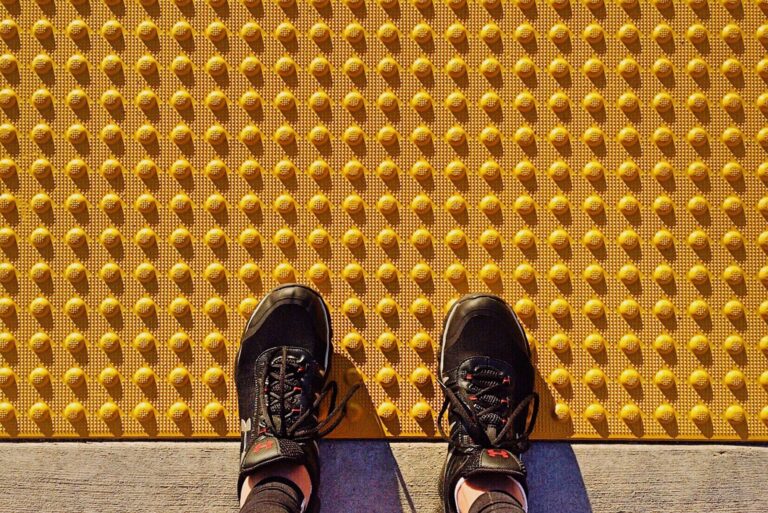
Understanding the different types of tactile pavement commonly used to warn, guide, and direct visually impaired pedestrians is fundamental in your adaptation journey. Learning to detect and interpret the messages within tactile paving slabs through your cane or underfoot is an important accessibility skill.
To be honest, I’m still not very good at interpreting the different vibrations my long cane transfers when it encounters tactile paving, as I still have enough limited sight to perceive a blurry approaching road crossing or stairway. Much easier to interpret is the clear message from subtle hints that the pavement has now turned into the road, tarmac into the earth, or even stable concrete floor into a bottomless abyss! Yet one of the rights of passage in becoming visually impaired and adapting to white cane usage is telling your tactile paving from its less artistic composite colleagues.
One of the great steps forward in aiding independence for visually disabled travellers is the now widespread adoption of textured or tactile ground surfaces within urban design. They are now widely present and placed at road curbs, station platform edges, the start of stairs, and when approaching road crossings as advanced warnings or alerts to take immediate action.
At the heart of the concept is a very simple system, either you pick up the first warning as vibrations through your long sensory cane, or you feel them through the soles of your shoes as a second warning. If both warnings fail to alert you, you have all eternity to realise and learn from your mistake in the afterlife! It is a simple system of two warnings, one finality, and your call!
A very quick history of Tactile Paving
The idea originates in the concept of braille; in fact, such paving is called Tenji blocks in Japan (their name for braille) and was first introduced in Okayama in 1967. The concept spread widely after its adoption by the Japanese railways. Through its railway connections, the concept spread to South Korea, and the concept was incorporated into the access designs of each facility at the 2000 Sydney Olympic Games and has since become ubiquitous in Australian public transport. The trend has continued globally and is now a factor in urban architecture within the UK, Europe and worldwide.
How the System works
There are effectively two types of blocks. The first has small braille-like round bumps on its surface, which are picked up by a sensory cane but, more importantly, felt through the soles of your shoes. These are known as warning blocks, and their use is for the visually impaired community and the elderly.

Diagram showing the two types of tactile paving (warning block & directional block). By Ice-cold121 – Own work, CC BY-SA 4.0,
The second type is directional blocks (or aids), which are made up of long, slender projecting ridges on their surfaces.
In the United Kingdom
The UK Department for Transport has established guidelines for the installation and placement of tactile ground surfaces.
The guide sets out the series of dots or bars to be installed at pedestrian crossings, refuges, railway stations, underground systems, and at the top and bottom of stairs. The Guidelines recommend colour differences to help people with low vision navigate different types of road crossings safely, but many locations do not conform to the recommended colours or incorrect slabs are laid when repairs are made.
Three configurations that are most useful in the UK for visually impaired people are those that help individuals align with rail platforms at Stations, the L-shaped configuration for pushbutton-controlled pedestrian crossings, with the corner of the L marking the location of the push button, and the basic design warnings at the top and bottom of stairs.
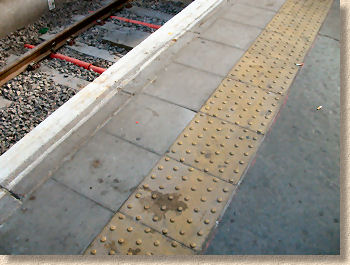


Picture: Image Source- Guidance on the Use of Tactile Paving Surfaces, DfT
The Six Types of Tactile Surfaces Used in the UK
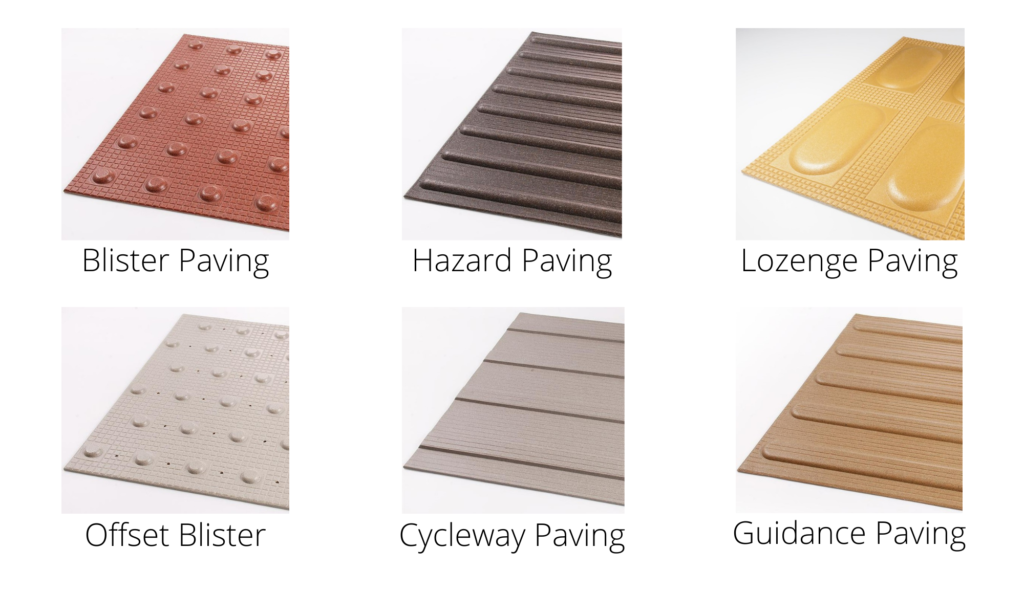
Recognizing the Sensory Message
Warning block

Blister (or Braille) Surfaces
Commonly used in tactile paving at Pedestrian Crossings, it shows the location and type of pedestrian crossing.
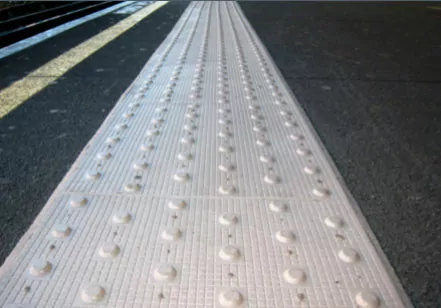
Offset Blister Surfaces
Flat-topped ‘blisters’ arranged in an offset pattern indicate the edge of a railway or underground tube station platform.

Lozenge-shaped bumps Surfaces
This is a Hazardous Warning surface commonly used at rail, tram, or light rail transit (LRT) platforms and increasingly at bus stops in the open street.
Directional Blocks
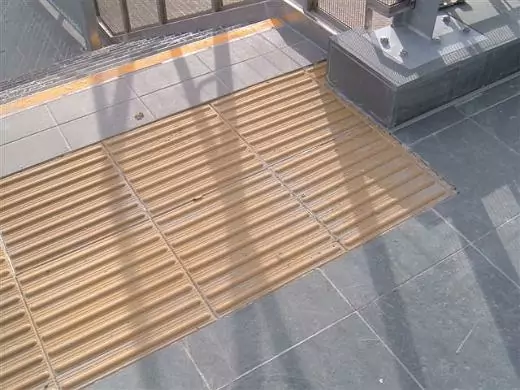
Corduroy (or Ridged) Surfaces
This is a Hazard Warning Surface, commonly used to indicate the presence of nearby hazards such as steps, platform edges, or cycle paths.

Cycleway or Tramline (or trackway) Surfaces
These flat-topped bars indicate which side of a shared footpath/cycle track is for pedestrians and which side is restricted for cyclists.
The cycle direction tracks can be confused with guided path paving (see below), but the clearest sign is that you can sense both horizontal and linear tramlines (often separated by a central horizontal ridge) when it is laid out in front of you.
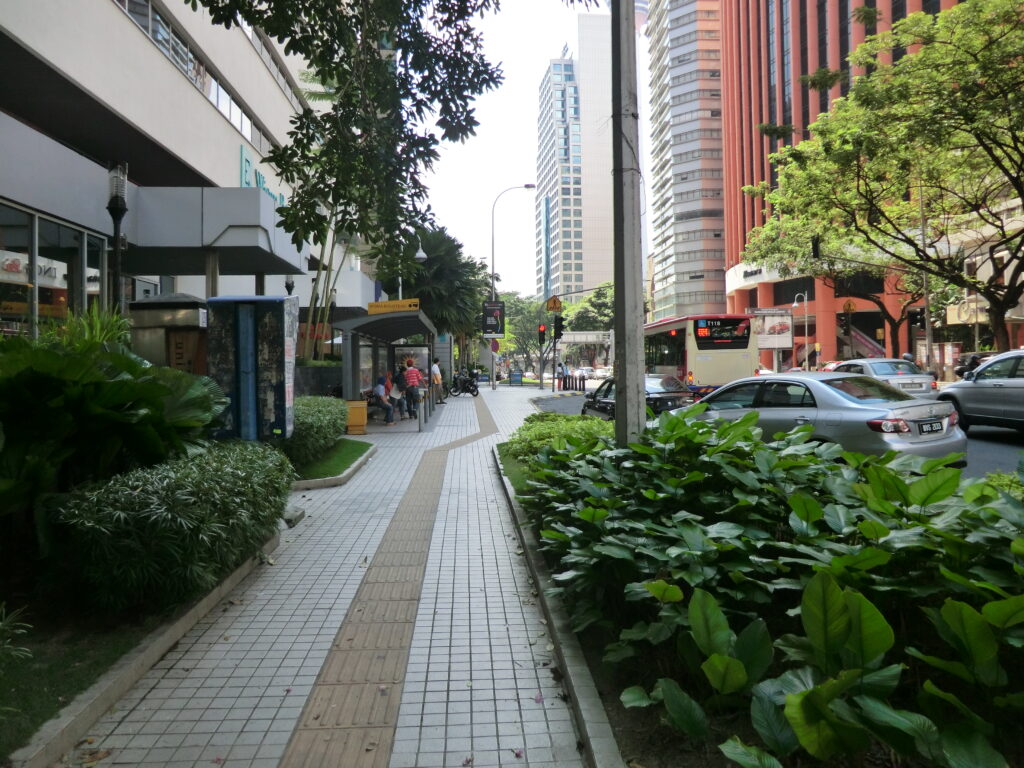
Guidance Path Surface
Flat-topped bars with rounded edges are used to guide you through open paved or concourse areas and around obstacles. They are increasingly being found in airports to help guide you towards terminals.
Colour and Occurrence
Around the world, many types of paving have now been manufactured and installed; for international travellers, this can be confusing at times.
Usually, the colour of the tile is used as a warning, and its bumps or ridges are used as a sensory or directional guide. Due to city geography, this becomes even more confusing when the tiles are laid badly or on a hillslope.

Yellow is the ubiquitous colour for warning, although it is common to come across red, orange or even black-toned street, stair or platform tiles. The paving contours are sometimes produced by embedding steel stripes and dots into their surface.
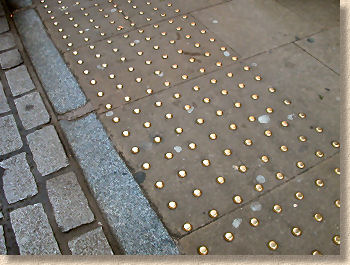
Hotels, often looking for a chic or modern appearance will often throw out convention to guarantee a more landscaped frontage, keeping tactile guidance but using non-standard designs.T
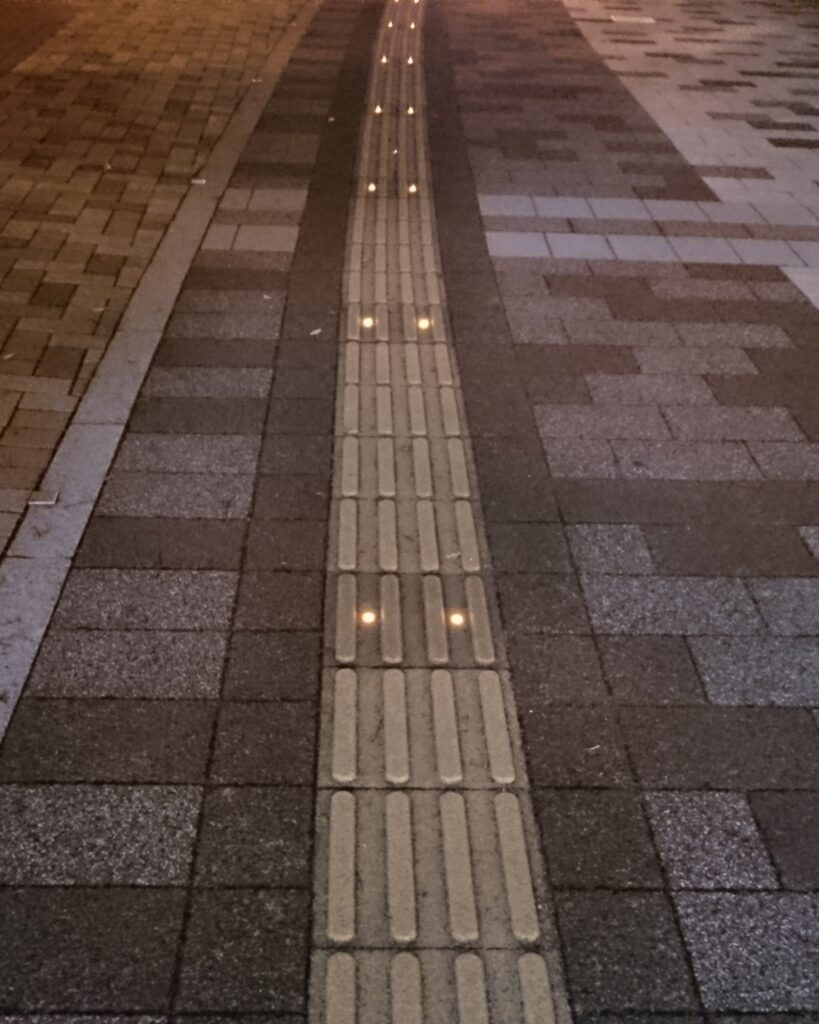
Tactile paving with LED By よよたは – Own work, CC BY-SA 4.0,
The Future
It will be interesting to see what the world comes up with next in this area, from tactile paving with LED lights inset to help people with low vision or the incorporation of tactile GPS navigation strips to help the visually impaired navigate specific shops, facilities or addresses.
What is of interest, though, is the ongoing debate about the use of tactile warnings within buildings; the debate seems to centre on whether installing them inside buildings may cause a tripping hazard! There are not many reports of the elderly or visually impaired tripping over them in the street, and certainly they have stopped us falling down stairs, perhaps the issue is more detailed and lies in the fact that we tend to wear more sensible shoes?
However good the directions and warning that such tiles provide us, we will always be at risk of idiots blocking the public paths with mopeds and other obstacles, as this one from Vietnam shows.





Leave a Reply